Laura Brodie
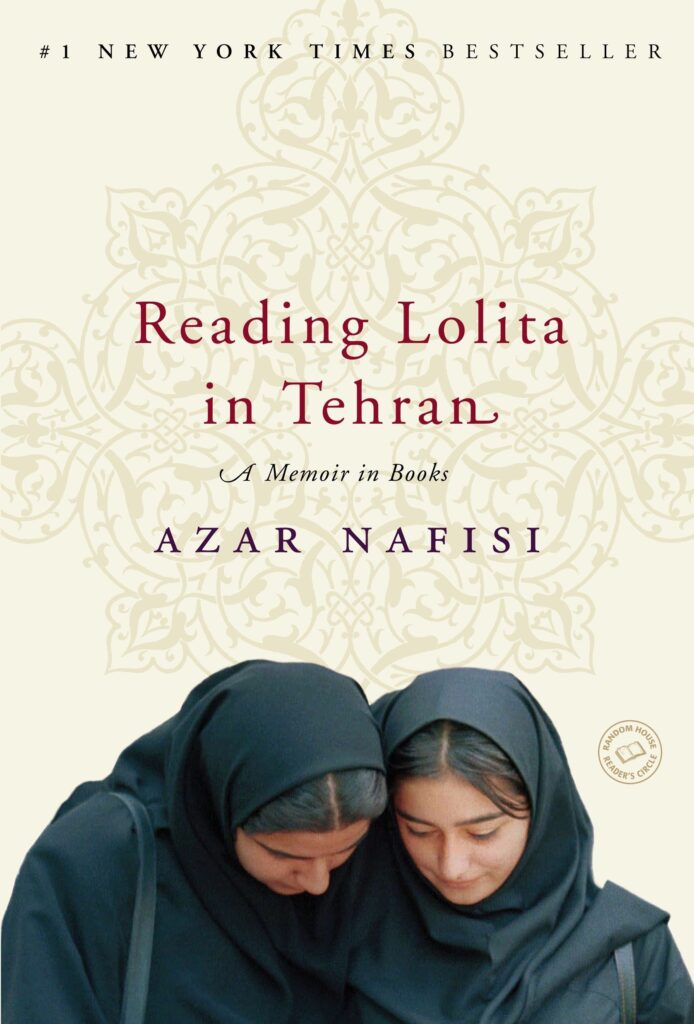
Azar Nafisi was a brand new professor of western literature at the University of Tehran, when Iran’s Islamic Revolution occurred in 1979. After years of struggling to teach under a theocratic regime that banned western literature and severely restricted women’s freedoms, Nafisi resigned her professorship in 1995. She then invited seven of her best women students to meet weekly in her house, to have their own private discussion of literature. After Nafisi and her family emigrated to America in 1997 she wrote a memoir about that “class.”
ENG 285—Reading Lolita in Lexington uses Nafisi’s memoir as a lens for studying three novels, The Great Gatsby, Lolita and Pride and Prejudice. This class explores how Nafisi’s students responded to these novels, and how the works’ major themes played out in Nafisi’s life, and the lives of Iranian women. We also learn about the history of Iran, from Cyrus the Great forward, and the central tenets of Islam. Although the main project is a final paper, students also complete a brief journalism assignment, surveying attitudes about Islam and Iran on campus at Washington and Lee. When this course was last offered in 2019, students shared their findings in posters such as the one shown here, which uses the design of Iran’s flag as its background.

In 2025 students wrote the text below and gathered the accompanying images, which share what they learned during their in-person interviews with twenty of their peers.
Key Takeaways from Interviews in 2025
Facts about Islam are scarcely known across the W&L campus.
Some students are aware of a few historical details, such as how Islam “was started by the prophet Mohammed in the 7th century, who saw himself as the final prophet of the Abrahamic religion, and recognized Jesus as a prophet,” and that “Christianity, Islam, and Judaism are all Abrahamic religions, sharing the same God.” Others mention practices regarding the pillars of Islam: “certain prayer times throughout the day, certain fasting times throughout the year,” and “Muslim communities celebrate two Eids: one is Eid of Iftar right after the end of Ramadan, and Eid al Adha.” However, misconceptions are frequently interwoven within what W&L students know to be facts of Islam, such as “Women have to cover themselves fully and don’t have many rights. They’ve been fighting Jews forever,” and “I know it is a very strict religion and that Mohammed had many wives.”
The belief that Islam restricts women and their rights is often echoed as a flaw within the Abrahamic religion. This view stems from the Western lens that depicts a radicalized Islam, which is weaponized by extremists and displayed as abnormality when compared to Western norms. In a society where women and young girls are sexualized as a means of empowerment, a woman’s decision to cover is often understood as oppression rather than freedom, especially when associated with a religion tainted as radical by mainstream media. Yet Western criticism focuses on women’s bodies in terms of freedom, while in Islam, those freedoms are extended to inheritance, education, leadership roles, and ownership. This does not negate that patriarchy and power structures, whether political or religious, often justify control under the guise of faith. Both realities exist and are not mutually exclusive. However, Western perspectives often fail to distinguish between the religion itself and the actions of those who misuse it.

We asked students if they could name any of the five pillars of Islam, and compared their answers with the 2019 results. These pillars include a declaration of faith, the responsibility of giving to the needy, prayer five times a day, pilgrimage to Mecca, and fasting during Ramadan. There is not much of an observed difference here, as the majority of respondents still couldn’t name any pillars. This is an interesting result, and shows that there is not much knowledge at W&L about Islam.


When asked to explain their understanding of the hijab, most students were able to recount its basics: “It is a cloth used to cover up the hair.” “Garment/headdress worn by women.” “A traditional covering for women to preserve their privacy.” However, negative connotations associated with the hijab within Western culture were also prominent: “It’ s a modesty thing. Sometimes it isn’t a choice for women but in other places it is.” “My understanding of the hijab is that they cover themselves fully so that people don’t have sexual impulses or attractions to women, but I think it’s a very flawed thing to do to make a woman cover up instead of taking responsibility for your own actions and your own sexual desires.” The understanding that the hijab is an obligation solely upon women and their chastity revolving around the male gaze is a common yet misconstrued definition of the hijab.
Although W&L students in both 2019 and 2025 showed mixed understandings about hijab, the students in 2025, reflecting deeper religious understanding, showed a stronger attempt to move beyond surface-level responses. In the Quran, after the revelation instructing men to lower their gaze, the command regarding hijab was revealed as an obligation upon men and women, emphasizing modesty in both appearance and character. For men, physical modesty refers to the loose, opaque clothing that covers from the navel to the knees. For women, it refers to loose-fitting clothing that covers the entire body, including the hair, while allowing the face and hands to remain visible. The picture included here shows a woman in a chador—standard dress for women in Iran, though not typical for most Muslim countries.
When asked “What do you know about Iran or any other Islamic countries?” and “What is the first word that comes to mind?” the answers suggested that students’ perceptions of Iran and other Islamic countries are largely shaped by conflict, and most likely the portrayal of these conflicts in American media. Common associations included war or terrorism, with several students referencing direct tensions with a variety of countries. One student remarked, “I know the U.S. has bombed them terribly,” most likely mistaking Iran for Iraq, while another described the region as “impoverished, not that established.”
While most responses reflected a focus on violence and instability, several acknowledged Iran’s geographical location or awareness of variations in Islam. One student noted, “Iran practices a Shia Islam which is one of two orientations in Islam. Iran has deviated towards an extremism in Islam in previous decades.” Overall, the first words students commonly associated with Iran were: war, desert, Middle East and terrorism, reflecting a mix of stereotypes and limited knowledge. Overall, in 2025 students’ association of Iran with war and terrorism seemed to be consistent with 2019, when 79% of students believed that the US should consider Iran a state sponsor of terror.

When asked about their opinions on the prevalence of Islamophobia at W&L, the results were interesting because students believe W&L to be less Islamophobic than the U.S. overall. Since W&L is an institution of higher learning, and only 31% of Americans have earned a college degree, students seem to assume that people who are more educated are less likely to stereotype others. Nevertheless, the results show that students believe almost 50% of Washington and Lee students are Islamophobic.
One way to combat Islamophobia is to visit a predominantly Muslim country. Most Washington and Lee students have never visited Iran or another Muslim country, but many express interest in doing so. Curiosity about different cultures, religions, and personal connections were common reasons, with one student sharing, “My best friend is Pakistani, so I would love to visit her family,” and another saying, “A goal of mine is to travel and experience other cultures I haven’t encountered yet.” Several mentioned they would want to visit Iran if they felt safe and welcome.

In addition to one student who was born and raised in Tunisia, the only countries that were directly mentioned as having been visited were Iran and Morocco. The students who visited Morocco seemed to have a positive view, while the student who had visited his grandparents in Tehran was hesitant to return due to the current political climate.
